
Inside the "Chopped Man Epidemic"
Another sign of how our expectations around gender roles are being rewritten in real time.

What’s Going On?
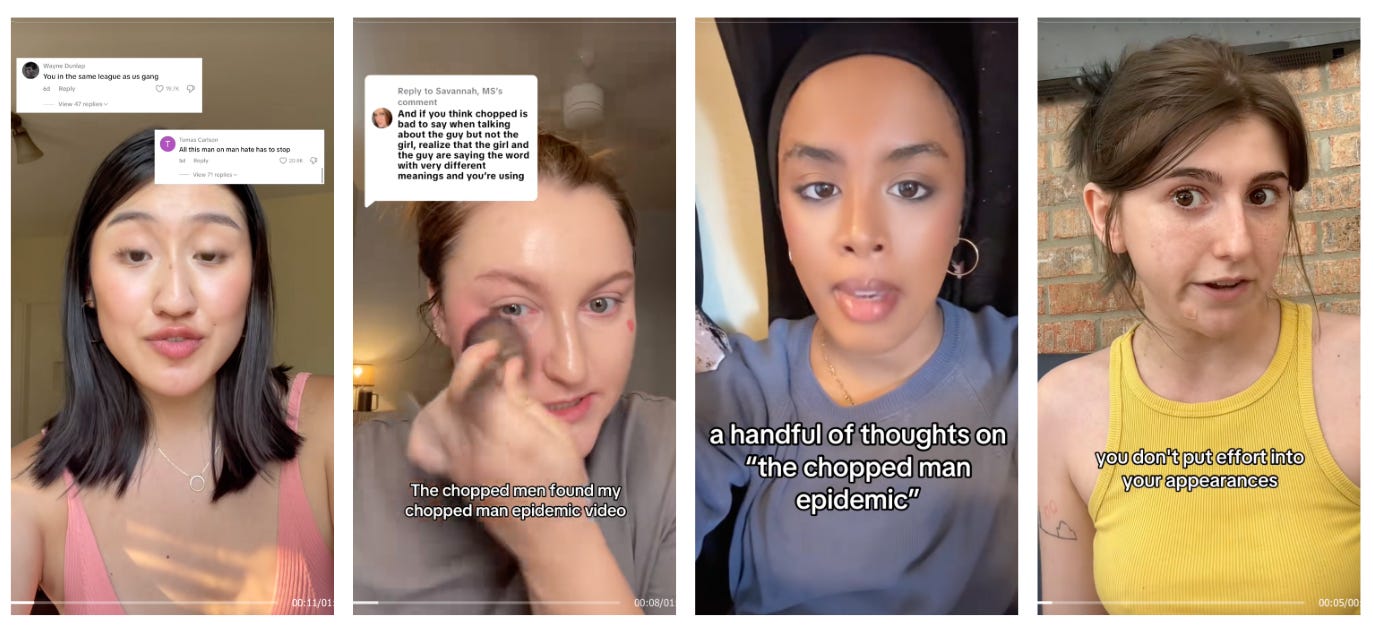
On June 6, TikToker Stella posted a short TikTok about how “We are living through a chopped [= unattractive] man epidemic.”
Though Stella got a significant amount of backlash, especially from the dudes who predictably derided her own appearance, many women agreed – Lightsabervibrator says:
“Y’all are ugly; you don’t put any effort into your appearances, and you don’t have any hobbies.”
Similarly, Loserbugg emphasizes that “it’s fixable,” as in, many men could easily work harder at making themselves more attractive. Because it’s not just about looks – “chopped man” has essentially become a broader shorthand for men who bring less to the table than they take.
What’s Driving It?
The Chopped Man sits in the context of a larger reappraisal of traditional gender norms and expectations.
In 2021, Anne Helen Petersen explored why educated liberal women often stay in mediocre “blue” marriages rather than face the “terror” of divorce.
Social media (especially TikTok) amplified that specific kind of disillusionment. As TikToker Hope Peddler put it:
“Women are figuring out that their unhappiness within heterosexual relationships, particularly marriage, is a feature, not a bug – and the only reason we’re realising this is because we’re talking to one another.”
A recurring theme? “Statistically, the happiest people on earth are married men and single women” (data likely taken from this LSE study). It’s featured in hundreds of videos and is clearly hitting some kind of nerve: this one has thousands of likes.
There are also videos where men act problematically, which social talkability and shareability are giving getting wide exposure:
Grooms smashing wedding cakes “as a joke” while their brides look on in horror
Men publicly humiliating their female partners, playing it off (again) as a joke
Expectant dads being aggressively disappointed at gender reveals when it’s a girl
This is also giving rise to its own vocabulary: the “Shut Up Ring” (an often low-quality engagement ring – courtesy of Cecelia Regina) and “King Baby”, people looking for their relationship partner to act as their caregiver (codified by Mel Hamlett).
And women are embracing the mindset “he’s competing with your peace and alone time.”
Against all this, the fact that women need to invest more not just into relationships but also their appearance seems almost laughably unfair.
What Does It Mean?
It’s not just about men who don’t put effort into their appearance – it’s a rejection of relationships that drain more than they give, and a signal that “bare minimum” just isn’t cutting it anymore.
On an individual level, it’s clear that effort matters. But (of course), there also a lesson for brands. Speak to the new set of expectations with a focus on equality, mutual respect, and effort – not tired stereotypes. The brands that thrive will be those that reflect and support this new set of expectations rather than clinging to outdated dynamics.
Final Takeaway
Call-out culture is turning quiet frustration into collective power. Whether you’re in a relationship or selling to people who are, ask yourself: am I adding value – or am I just here?
PS: Stella, the original poster, isn’t going down quietly – she’s actively embracing the controversy with videos like “tips on how to slow the spread of the Chopped Man Epidemic.”
Regarding "married men and single women are the happiest" claim. You linked to a story involving Paul Dolan. He later apologized because he discovered that he misunderstood the data that he was looking at. In other words: it's a myth.
More specifically, he looked at data where women were asked about their happiness. There was a category for married women, married women spouse not present, divorced women, widows, and single women. Paul incorrectly thought that "married, spouse not present" meant that the women were answering the question when their husband was out of the room. He took that to be a more truthful indication of married women's happiness (than the "married women" category). He compared that against single women and found single women to be happier than "married women, spouse not present". In actually, "married, spouse not present" meant that these women were married but separated from their spouse - most likely a prelude to divorce. He messed up his interpretation of the data.
In reality, married men are happier than single men, and married women are happier than single women. Also, married men and married women live longer than their single counterparts.