
The Low-Effort Personality Oracle
How seriously do people actually take them?

What’s going on?
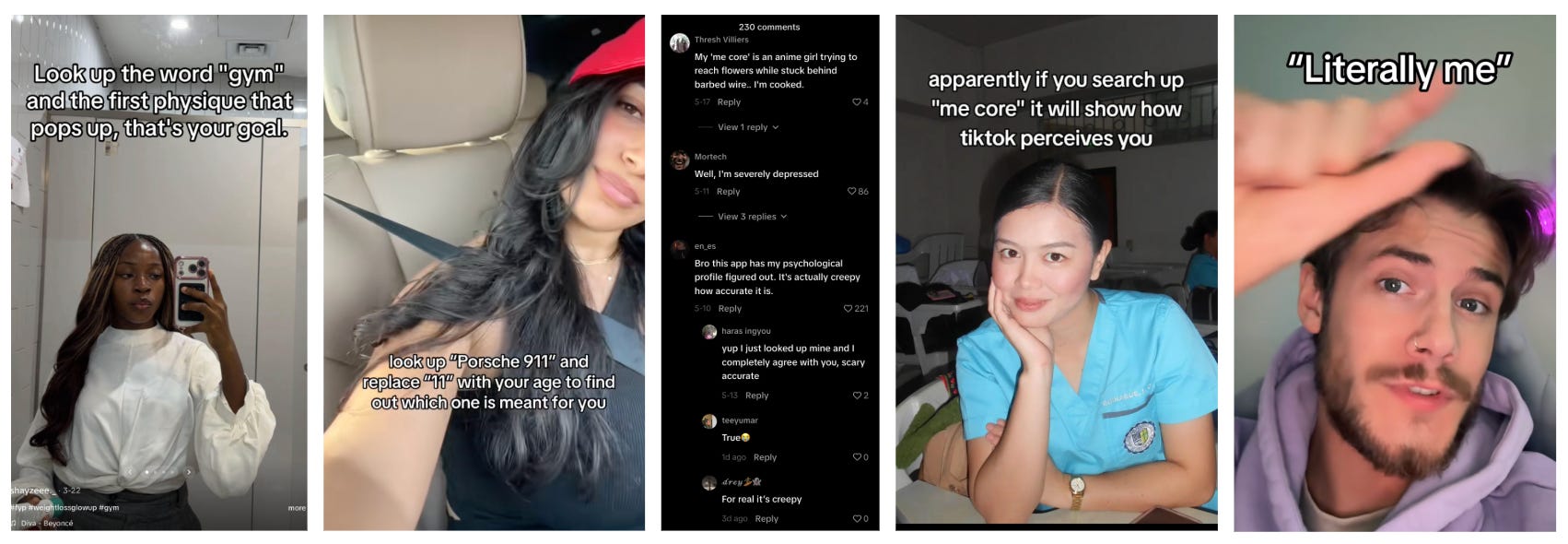
Looking to generate social engagement at speed? Just tell people what to search for to discover a new facet about themselves:
Search “me core” to see how TikTok perceives you. (Probably one of the most popular ones – variants include searching for “literally me.”
Look up “Porsche 911” and replace “11” with your age to find out which one is meant for you.
Look up the word “gym“ and the first physique that pops up is your goal.
And so many more.
Obviously a lot of people treat it as a joke – but others (like this comment section shows) are impressed: “This app has my psychological profile figured out. It's actually creepy how accurate it is.”
What’s driving it?
In part, it’s the latest evolution of the Buzzfeed personality quiz, which go back to the personality tests of the early 1900s. But it also contains a heavy dose of divination rituals, from the simple (apple divination) to the complex (like astrological charts).
To add another layer of complication: social algorithms HAVE, in some cases, helped people understand themselves better, from expanding their fashion and music tastes to discovering truly deep parts about themselves – think “The TikTok algorithm knew I was gay before I did” kind of stories (plus a slew of medical conditions, neurodivergencies, and mental health concerns). But at the same time: few people know how social algorithms actually work – so they see them as all-knowing. (The algorithm as digital fortune teller.)
What does it mean?
Most of us know we’re biased when it comes to perceiving ourselves as we truly are. The appeal of personality quizes is that they promise to bypass conscious self-perception and reveal something “deeper” underneath. And in an internet culture where identity is often conflated with hyper-specific archetypes, being instantly categorized as anything from “clean girl” to “frazzled Englishwoman” can provide some measure of comfort.
And the format thrives because it delivers the right kind of ambiguity. If it resonates, it feels meaningful. If it doesn’t – it was only a joke anyway.
Final takeaway
There are a lot of people online who want to be told who they are and what that means – they’re seeking relief from ambiguity and choice overwhelm. And yet: they’re seeking that relief from systems that can’t actually know them on a deeper level – just what’s most likely to keep them engaged.