
The "The Hunger Games, But Better" Is Actually Kind of Better?
And it reflects a new shift in willingly suspended disbelief.

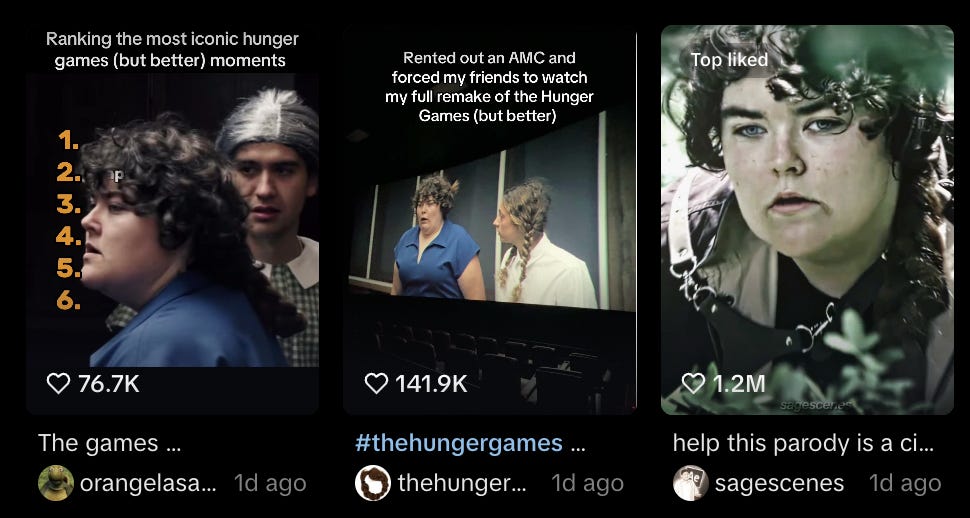
What’s going on?
The Hunger Games, But Better is a 42-minute Hunger Games homage / parody / fever dream – and it’s rapidly become an online sensation. Shot by Grace Reiter (American High Shorts) and her friends over three days for her 24th birthday and released on November 19, it’s just passed 4 million YouTube views.
What’s driving it?
Reiter and her crew clearly know how online storytelling in the parody space works, from pacing to fan-service to self-aware subversions (note that the BTS is almost as long as the movie itself). It’s the same reason Lower Decks is the best Star Trek: it genuinely loves the thing it’s riffing on. And given that Hunger Games prequel Sunrise on the Reaping trailers are starting to make the rounds, the timing is perfect.
And, of course, THGBB is coming at a time where creator-made “mini-movies” are becoming serious business. THR warned back in March that younger viewers choose creator content over premium TV and movies – and though this alarmism is based on a study from “lol we make up our data” Deloitte, and UCLA data (and box office figures) showed that audiences very much still watch movies and TV, it still reflects a biggre shift: even if creator work isn’t necessarily “replacing” traditional mainstream entertainment, the success of THGBB shows that it’s seen as a valid alternative with its own rules and not a “well, if we don’t have anything else” substitute. (Also: people are already demanding a Twilight version.)
What does it mean?
A good hundred years ago, Brecht leveraged the idea of the Verfremdungseffekt to deliberately remind audiences they were watching art so they could think critically about it. Creator-made content like THGBB reflects the next stage of that: art where everyone is in on the joke and no one’s tryint to trick you. (And, of course, it’s clearly untouched by AI or CGI for the purposes of immersion.)
And though THGBB couldn’t exist without the OG Hunger Games, it’s nonetheless “better” in that it can be more self-aware than the original – and involve the audience more (as per the resulting online discourse).
Final takeaway
THGBB took off in a big way because creator projects have become their own genre of art, with a fresh spin on what willing suspension of disbelief looks like. The real test will be if audiences will then start expecting this same sense of openness from mainstream entertainment – and how studios can deliver it in a way that feels engaging rather than engineered.