
When Your Digital Avatar Has a Better Social Life Than You
What are we actually doing when we send hyperrealistic AI-generated avatars of ourselves on adventures out of our own reach?

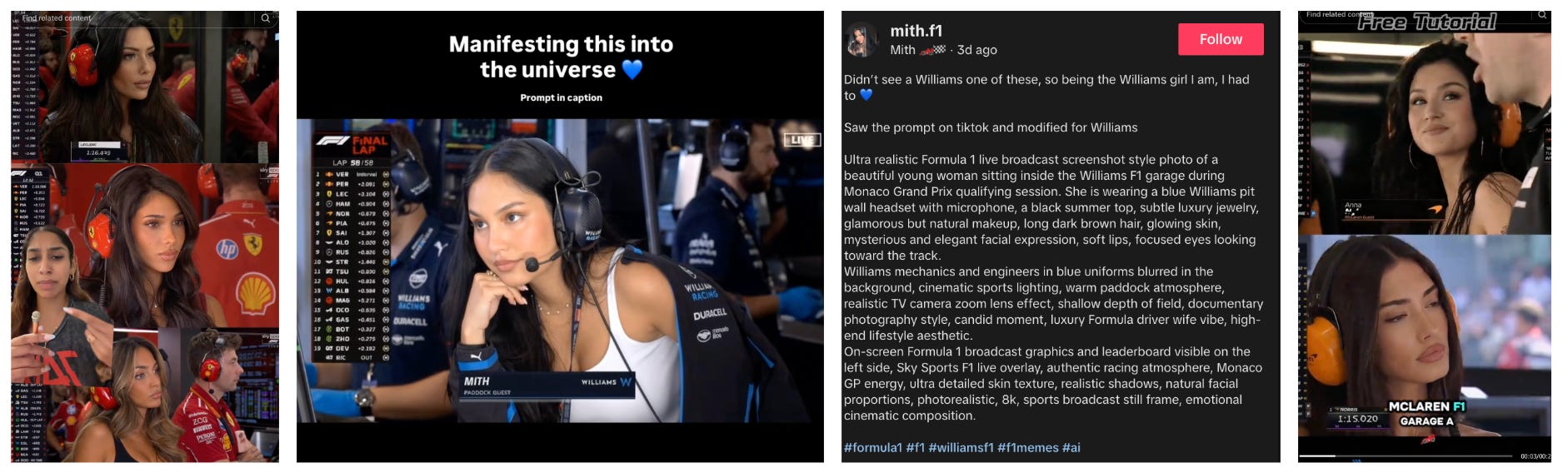
What’s going on?
TikTok is calling is the “F1 AI garage trend” – essentially, we have people portraying (often glambotted) versions of themselves in photos or short video clips where they’re at specific events (yes, also beyond the world of motorsports). Plus, of course, a whole cottage industry around tutorials for how to create the look yourself.
What’s driving it?
In large part? Because the technology got good enough – and humans are clearly hard-wired to create self-insert fan fiction. If Dante had to settle for writing himself into the Divine Comedy in the 1300s, in the 2020s, you don’t need budget and / or artistic skill – just the right prompt.
And like the “AI turn me into an action figure” and “AI turn me into a Barbie“ trends, it’s a way to show your interests.
Plus: at a moment when many people feel constrained – financially, socially, geographically, professionally – AI offers frictionless escapism.
What does it mean?
Of course photos too have always been susceptive for manipulation (as Stalin’s propaganda machine can attest) but they still came with an implicit promise: this happened. It might not have looked exactly like this, but it happened.
The point of the “F1 AI garage trend“ isn’t to trick anyone (though that can be a consequence) – everyone knows the images are fake. It’s more about taking our digital avatars on more adventures.
And because everyone understands it’s fiction, they often feel socially acceptable in a way other forms of fakery didn’t – because it’s about collectively participating in a shared imaginative game.
Final takeaway
When we send our AI-generated selves on adventures, we externalize our imagination – but does this inspire us to go on real adventures, or replace that urge?